Overview
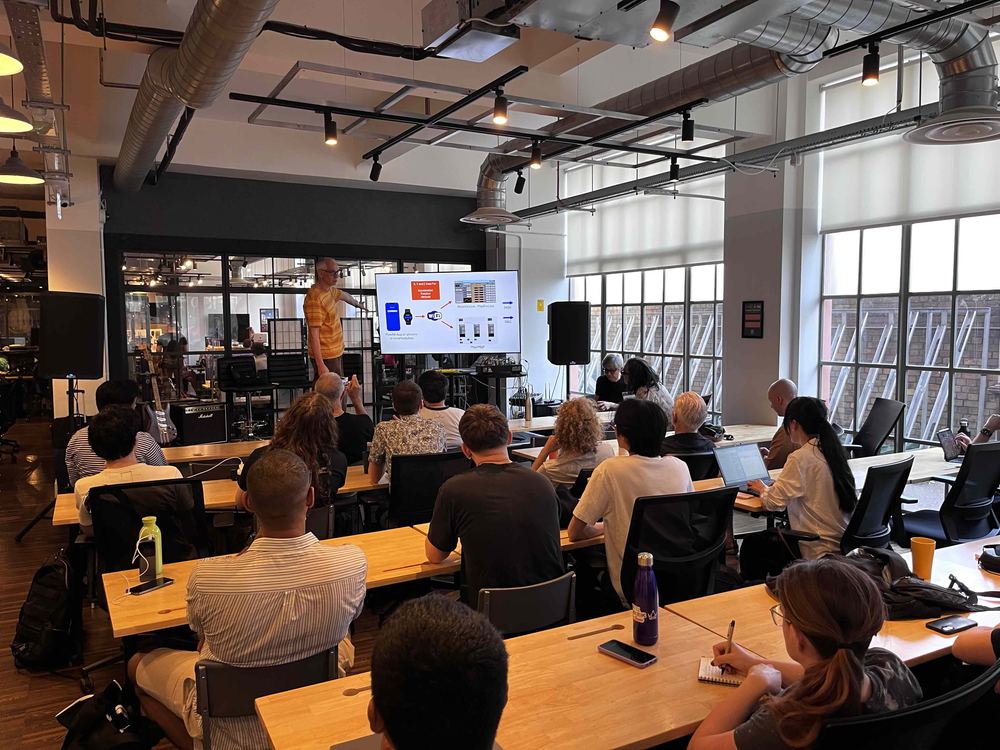
Session #03 of Audio Buffer London. This session explores the technical and philosophical pillars of embodied interaction. Bridging the gap between human physiology and digital synthesis has always been a frontier for electronic music.
When we gesture, we are thinking with our bodies — delivering continuous data to the machine to weave a sensate, real-time sonic world.
Today, advancements in bio-mechanical sensors and everyday mobile technology allow us to democratize this process. By translating physical effort into raw sound data, we are turning the human body and our smart devices into living musical instruments, allowing us to physically push sound through 3D space.
The first part of our session welcomed our guest presenters on this topic. Incredibly honored to be joined by sound artist, researcher, and academic Atau Tanaka (Professor of Media Computing at Goldsmiths, UoL). Atau uses electromyogram (EMG) sensors to capture the electrical impulses of his own muscle tension, transforming corporeal gestures into sonic reality.
Following him, artist and creative technologist Simon East presented Flowfal, an innovative system that allows movement from the sensors on standard smartphones and smartwatches to interface directly with Ableton Live and Max/MSP for immersive spatial audio and visual control.
The second part of our session was dedicated to Student Prototypes: Under the Hood Live "Code & UI" reviews. This month, Nicolas Arellano Guzman (Goldsmiths, University of London) presented his new synth plugin, Sinesthesia, which promotes creative expression via a multi-modal interface. The project visualizes synth parameters and spectral information in real-time, drawing inspiration from cymatic images and the neurological condition of synesthesia.